
Published July 29, 2026. Market data as of the dates noted.
Large cap growth has given back its year-to-date gains. Value has moved ahead. The obvious read is a rotation out of technology, and at the index level that is what the numbers show.
The less obvious read is that some of the rotation is definitional. In June, the annual Russell reconstitution moved several of the largest technology companies across the growth and value line. Which means an investor who believes they reduced technology exposure by tilting toward value may not have reduced it at all.
At Avion Wealth, this is the kind of detail that surfaces in portfolio reviews rather than in headlines. The market move is real. So is the possibility that a portfolio’s actual exposure no longer matches its labels.
Why the Selling Started With Valuation, Not Fundamentals
The companies at the center of the AI trade were priced on an assumption of near-flawless execution. When a security is valued that way, ordinary results become disappointments, and the repricing happens through the multiple rather than through earnings.
The Philadelphia Semiconductor Index had rallied more than 130% in the twelve months leading into the July selloff, reaching an all-time high of roughly 14,655 on June 22, 2026. Appreciation at that pace compresses the room for error. Samsung Electronics illustrated the dynamic when it reported preliminary second-quarter operating profit representing a nineteen-fold increase from the prior year, and its shares fell roughly 7%.
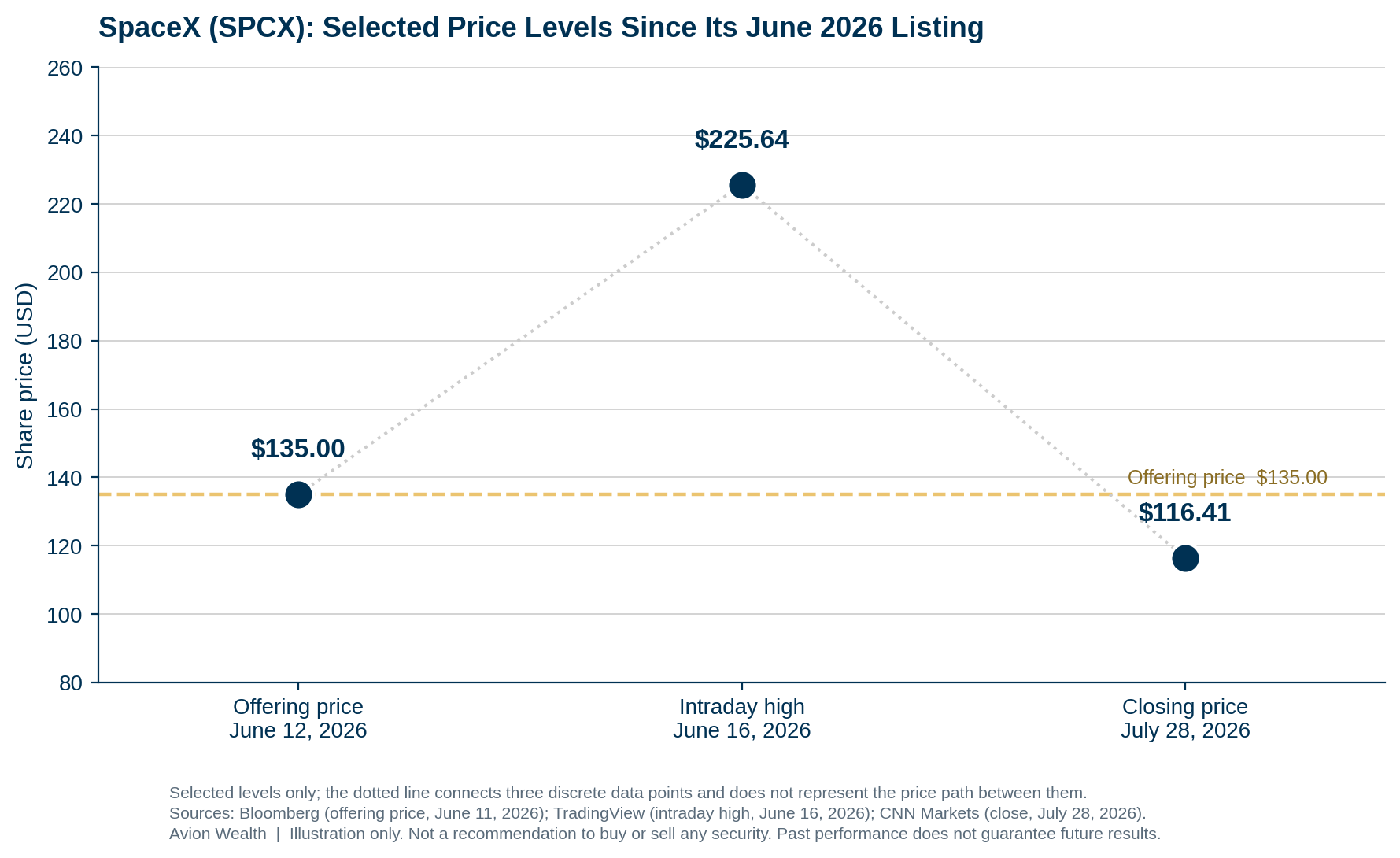
The most visible example arrived through the year’s largest offering. SpaceX priced 555.6 million shares at $135 each in June, raising $75 billion in the largest IPO on record. The shares reached an all-time high of $225.64 on June 16 and closed at $116.41 on July 28 — roughly half the peak, and below the offering price. This is offered as an illustration of how quickly a valuation premium can compress. It is not a view on the company and not a recommendation regarding any security.
What Credit Spreads Are Signaling That Equity Prices Are Not
Equity prices show what investors will pay. Credit spreads show what they think the risk of failure is. The two do not always move together, and when they diverge, the credit market is often the more informative of the pair.
Delivering on AI capacity requires capital expenditure measured in the trillions, and a meaningful share of it is financed rather than funded from operating cash flow — some of it through structures that do not appear plainly on a balance sheet. On July 28, the Financial Times reported that credit default swap spreads on Oracle, SpaceX, Alphabet, Amazon, Meta, Broadcom and Nvidia were reaching record highs, with the uncertainty centered on the pace and cost of funding alongside questions about return on that investment.
A credit default swap is, in plain terms, insurance against a borrower defaulting. When the cost of that insurance rises across an entire group of issuers at once, the market is pricing a higher probability of strain. That does not forecast failure. It does mean the financing question has moved from theoretical to priced.
The Historical Pattern is Overbuild, Not Collapse
Capital-intensive technology cycles tend to follow a recognizable sequence. Capacity gets built ahead of demand. Capital is raised faster than revenue can service it. Then the industry rationalizes — consolidation, write-downs, and a smaller set of survivors operating the infrastructure the first cycle financed.
The late-1990s telecommunications buildout is the closest parallel. Enormous amounts of fiber were laid, far more than contemporaneous demand required, and much of it was debt-financed. Many of the companies that built it did not survive. The fiber did, and it carried the traffic of the decade that followed. The railroad buildouts of the nineteenth century ran the same arc.
The distinction worth holding onto is between a thesis failing and a first cycle closing. AI revenue is growing quickly. It is not yet growing quickly enough to service trillions in industry-wide spending. Those are different statements, and conflating them is how investors mistake a rationalization for an ending.
The Index Change Most Portfolios Have Not Accounted For
This is where the market story becomes a planning question.

At the June 2026 Russell reconstitution, the Magnificent Seven weight in the Russell 1000 Growth Index fell from 52.1% to 43.1%, while its weight in the Russell 1000 Value Index rose from 5.5% to 15.7%. Apple, Microsoft and Amazon now carry meaningful weight in Value alongside Growth, and Information Technology plus Communication Services together account for 70.1% of the Growth index.
Two implications follow, and neither required the investor to place a single trade.
A value allocation now carries materially more mega-cap technology exposure than it did a year ago. The diversification benefit an investor believed they held may be smaller than assumed. Separately, the growth sleeve became more concentrated, not less, with NVIDIA at 13.7% anchoring it. A portfolio can look identical on a statement while its underlying risk has shifted.
For a senior executive already holding concentrated equity compensation in one of these names, the effect may compound: single-stock exposure through options or restricted stock, index exposure through the growth sleeve, and now additional exposure through the value sleeve that was intended as a counterweight. For someone approaching a career endpoint with a defined date, where the sequence of returns in the years immediately surrounding that transition carries outsized weight, the question is less about the AI thesis and more about whether current exposure matches the timeline.
Considerations that may be worth reviewing in either situation include the actual look-through holdings of each index position rather than the style label, the degree of overlap between concentrated compensation and index exposure, and whether rebalancing bands were set against an index composition that has since changed.
Where Policy Risk Sits in This
The Federal Reserve has held its benchmark rate at 3.50% to 3.75%, and resurgent inflation tied to rising energy prices has moved some forecasters from expecting cuts in 2026 to expecting increases before year end. Crude futures rose roughly 20% over July amid intermittent conflict between the U.S. and Iran.
In our current view, the primary risk in this environment is not the correction itself. Orderly repricing is how markets absorb changed information. The risk is an overreaction — whether a policy response calibrated to stale data or an investor response calibrated to headlines — that converts an orderly adjustment into a disorderly one. This reflects Avion Wealth’s opinion as of July 29, 2026 and is subject to change without notice.
What Coordination Looks Like Here
None of the above resolves into a single action. It resolves into a set of questions that deserve review: what a portfolio actually holds beneath its labels, how concentrated compensation interacts with index exposure, and whether the timeline for drawing on those assets has changed since the allocation was set. Where equity compensation, trust structures, or a pending liquidity event are involved, these questions are best worked through alongside existing legal and tax professionals rather than in isolation.
For those reassessing exposure in the current environment, Avion Wealth offers a complimentary Second Opinion Service, a review focused on how current positioning aligns with stated goals and timeline.
To your success,
The Avion Wealth Team
Frequently Asked Questions
Why are AI stocks falling in 2026?
The decline has been driven primarily by valuation compression rather than deteriorating fundamentals. Global semiconductor market capitalization declined by approximately $3.3 trillion between June and July 2026 while revenue at major AI companies continued growing. When a stock is priced for near-perfect execution, ordinary results can trigger a repricing on their own.
What do widening credit default swap spreads mean?
A credit default swap spread is the cost of insuring a company’s debt against default, so a widening spread means the market is pricing a higher probability of financial strain. Spreads on several large AI-related issuers reached record highs in late July 2026. Rising spreads signal increased perceived risk; they do not predict default.
Did the Russell index changes affect my portfolio?
Possibly, without any trade on your part. The June 2026 reconstitution reduced Magnificent Seven weight in the Russell 1000 Growth Index from 52.1% to 43.1% and raised it in the Russell 1000 Value Index from 5.5% to 15.7%. Any fund tracking those indexes changed its holdings accordingly. Whether the effect is material depends on the specific funds held and the rest of the allocation.
Is this like the dot-com crash?
The comparison is imperfect in an important way: many of today’s largest AI spenders generate substantial current cash flow, which most late-1990s telecommunications companies did not. The structural similarity is capital-intensive buildout financed ahead of revenue, which historically resolves through consolidation rather than through the underlying technology proving worthless. Past cycles do not predict this one.
Sources
- Bloomberg, “SpaceX IPO Raises $75 Billion in Biggest Debut of All Time,” June 11, 2026 — bloomberg.com
- CNBC, “SpaceX raises $75 billion in record-setting IPO ahead of Nasdaq debut,” June 11, 2026 — cnbc.com
- TradingView, SPCX historical price data, accessed July 29, 2026 — tradingview.com/symbols/NASDAQ-SPCX
- CNN Markets, SPCX quote and closing price, July 28, 2026 — cnn.com/markets/stocks/SPCX
- FTSE Russell / LSEG, “Growth, value or both? Key style shifts in the June 2026 Russell reconstitution,” June 2026 — lseg.com
- Meeder Investment Management, “When the Benchmark Moves: What the 2026 Russell Reconstitution Did to Growth and Value,” July 2026 — meederinvestment.com
- Financial Times, reporting on credit default swap spreads across large AI issuers, July 28, 2026 — ft.com
- Board of Governors of the Federal Reserve System, FOMC minutes, June 16–17, 2026 — federalreserve.gov
- CBS News, “Will the Federal Reserve raise interest rates? Here is what experts predict for July’s meeting,” July 29, 2026 — cbsnews.com
- Kiplinger, “July Fed Meeting: Live Updates and Commentary,” July 29, 2026 — kiplinger.com
Market data reflects the dates stated. Third-party sources are believed to be reliable but their accuracy is not guaranteed.